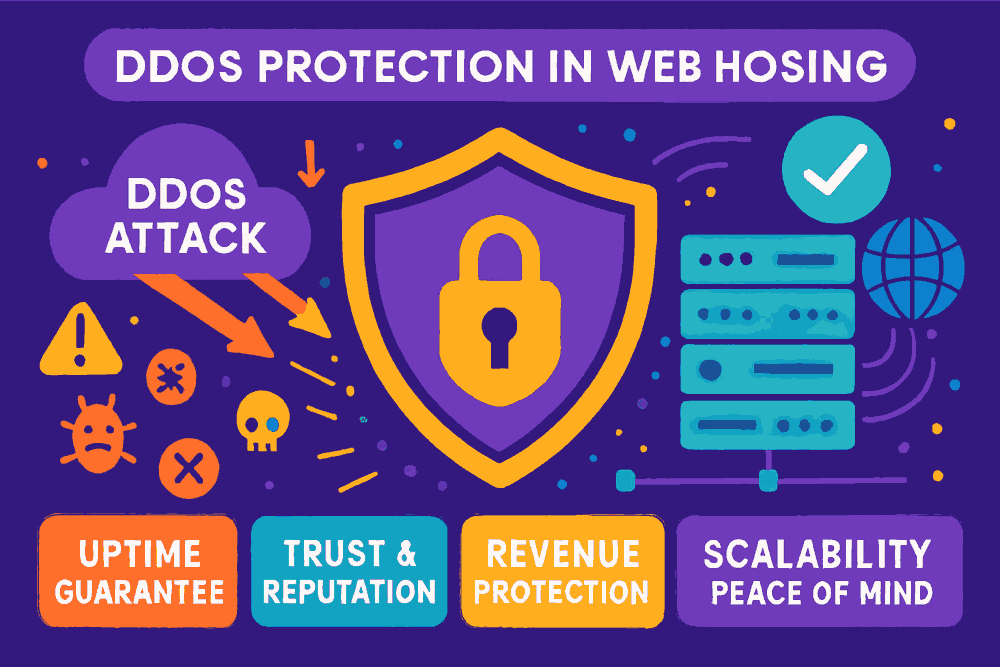
What is Denial of Service DDoS Attacks?
DDoS protection in web hosting is a security feature that shields
websites from Distributed Denial of Service DDoS attacks, which flood servers with fake traffic to
overwhelm them and make sites inaccessible. It ensures uptime,
reliability, and trust by filtering malicious requests while allowing
legitimate visitors through that tremendously improves your website
performance. Hosting companies like Contabo_Web_Hosting
has DDOS protection always enabled. To understand Distributed Denial of
Service DDoS attacks and Protection even
better, please continue reading:
1. Distributed Denial of Service DDoS attacks in Web Hosting
DDoS attacks protection in web hosting refers to the set of
technologies and strategies used to defend websites and servers from
Distributed Denial of Service DDoS attacks. These attacks aim to overwhelm a server with
excessive traffic, rendering it inaccessible to legitimate users.
Hosting providers implement DDoS protection through firewalls, traffic
filtering, rate limiting, and cloud-based mitigation services. The goal
is to ensure uninterrupted service availability, even during DDoS attacks. DDoS protection is an important component of modern web hosting,
especially for businesses that rely on consistent uptime and secure
online operations.
2. Understanding Denial of Service DDoS Attacks on Web Hosting Servers
A Distributed Denial of Service DDoS attacks involve multiple systems flooding a target server with
traffic, often using botnets which is a network of compromised devices.
Distributed Denial of Service DDoS attacks can be volumetric, protocol-based, or application-layer
focused. Volumetric DDoS attacks consume bandwidth, protocol attacks exploit
server resources, and application-layer attacks mimic legitimate user
behavior to exhaust server capacity. The complexity and scale of these
attacks make them difficult to detect and mitigate without specialized
tools. Understanding the nature of Distributed Denial of Service DDoS
attacks is essential for
implementing effective protection strategies.
3. Why Distributed Denial of Service DDoS Attacks Protection Is Important in Web Hosting
Distributed Denial of Service DDoS Attacks Protection is vital because it safeguards websites from
downtime, data breaches, and reputational damage. In today’s digital
world, even a few minutes of downtime can result in significant
financial losses and customer dissatisfaction. For e-Commerce platforms,
media outlets, and service providers, uptime is directly tied to revenue
and trust. Distributed Denial of Service DDoS Attacks Protection ensures that legitimate traffic can access
the site while malicious traffic is filtered out, maintaining business
continuity and user experience.
4. No Distributed Denial of Service DDoS Attacks Protection?Consequences on Web Hosting Could Be A Disaster
Without Distributed Denial of Service DDoS attacks protection enabled, a
web server is vulnerable to traffic floods that can crash the web
server. This leads to prolonged downtime, loss of customer trust, and
potential data exposure. Businesses may face legal consequences if
sensitive data is compromised. Recovery from an attacks involves
technical remediation, public relations efforts, and financial costs.
The absence of Distributed Denial of Service DDoS attacks protection leaves a website defenseless against
increasingly sophisticated cyber threats. Many Web Hosting Companies
especially the ones like
Contabo_Web_Hosting
and even the
Elementor_WordPress_Web_Hosting have DDoS protection always
enabled.
Watch this Educational Video on How DDoS Attack Happens.
5. Types of DDoS Attacks on Web Servers
There are several types of Distributed Denial of Service DDoS Attacks, each targeting different
aspects of a web server. UDP floods overwhelm bandwidth, SYN floods
exploit TCP handshake processes, and HTTP floods target web
applications. DNS amplification and NTP reflection attacks use
third-party servers to amplify traffic. Multi-vector attacks combine
these methods, making them harder to mitigate and bring under control.
Understanding these types helps in designing layered protection
strategies that address various vulnerabilities.
6. How Distributed Denial of Service or DDoS Attacks Protection Works
Distributed Denial of Service DDoS attacks protection works by identifying and filtering malicious traffic before it reaches the server. Techniques employed include rate limiting, IP blacklisting, anomaly detection, and traffic scrubbing. Advanced systems use machine learning to adapt to evolving attacks patterns. Cloud-based services distribute traffic across global networks, absorbing large-scale attacks and to prevent catastrophic server failures. Firewalls and intrusion prevention systems add additional layers of defense. The goal is to maintain service availability while neutralizing threats.
7. Cloud-Based DDoS Protection
Distributed Denial of Service DDoS attacks protection in cloud web hosting
offers scalable and flexible defense mechanisms. Providers like
Cloudflare, Akamai, and AWS Shield monitor global traffic and respond to
threats in real time. These services are ideal for businesses with
limited in-house security resources. Cloud solutions can absorb massive
traffic volumes and provide detailed analytics. Integration with
existing web server and infrastructure is typically seamless, making
deployment straightforward and effective.
8. On-Premises DDoS Protection
On-premises Distributed Denial of Service DDoS attacks protection involves
deploying hardware and software within the organization’s network. These
systems offer granular control and customization but require significant
investment and expertise. They are suitable for organizations with
strict compliance requirements or sensitive data. Combining on-premises
and cloud-based solutions creates a hybrid approach that maximizes
coverage and resilience against diverse DDoS attacks vector.
9. Distributed Denial of Service DDoS Attacks Protection and Role of Web Hosting Providers
Hosting providers play a key role in Distributed Denial of Service DDoS attacks protection by offering built-in mitigation services. They monitor traffic, implement firewalls, and collaborate with ISPs to block malicious requests. Premium hosting plans often include advanced Denial of Service DoS attacks protection features. When choosing a web hosting provider, businesses should evaluate the provider’s security infrastructure, response time, and support capabilities. We recommend Contabo_Web_Hosting and the Elementor_WordPress_Web_Hosting companies with DDoS Protection enabled, for all your web hosting needs.
10. Best Practices for DDoS Prevention
Effective
Distributed Denial of Service DDoS attacks prevention
involves implementing best practices such as using web application
firewalls, enabling rate limiting, and maintaining updated software.
Regular security audits and penetration testing help identify
vulnerabilities. Network segmentation and redundancy improve resilience.
Monitoring traffic patterns and setting up alerts enable early
detection. For any company, its employee training and incident response
planning ensure preparedness.
11. Importance of Distributed Denial of Service DDoS Attacks Incident Response Plans
An incident response plan outlines the steps to take during a
Distributed Denial of Service DDoS Attacks. It includes roles, communication protocols, and recovery
procedures. Having a plan reduces confusion and accelerates mitigation.
The plan should be tested regularly through simulations. Coordination
with hosting providers and security vendors is essential. Documentation
and post-incident analysis help refine future responses.
12. Distributed Denial of Service DDoS Attacks Legal and Compliance Considerations
Organizations must consider legal and compliance implications of
Distributed Denial of Service DDoS Attacks. Data breaches resulting from attacks may trigger regulatory
violations. DDoS attacks reporting requirements vary by jurisdiction.
Failure to implement adequate DDoS protection can lead to legal
liability. Businesses should consult legal experts to understand their
obligations. Maintaining logs and evidence supports investigations and
potential litigation.
13. Cost of Distributed Denial of Service DDoS Attacks Protection
The cost of Distributed Denial of Service DDoS attacks protection varies based on the solution’s complexity
and coverage. Cloud-based services offer subscription models, while
on-premises systems require upfront investment. The cost should be
weighed against potential losses from an attacks. ROI can be measured in
terms of uptime, customer retention, and avoided recovery expenses.
Budgeting for DDoS protection is a strategic decision.
14. Case Studies of Distributed Denial of Service DDoS Attacks
Real-world examples of Distributed Denial of Service DDoS Attacks highlight the importance of DDoS
protection. The 2016 Dyn attack disrupted major websites like Twitter
and Netflix. The Mirai botnet exploited IoT devices to launch massive
assaults. These incidents underscore the need for proactive defense.
Studying case studies helps organizations understand DDoS attack vectors and
mitigation strategies. Lessons learned inform policy and infrastructure
improvements. That is why we have always recommended customers to go for
web hosting from companies like
Contabo_Web_Hosting
and
Elementor_WordPress_Web_Hosting which are known to have
highly secure servers which can protect your websites from Distributed
Denial of Service DDoS Attacks
and from any type of cyber attacks.
15. Role of AI in Distributed Denial of Service DDoS Attacks Defense
Artificial Intelligence enhances
Distributed Denial of Service DDoS attacks protection in Web Hosting by
analyzing traffic patterns and predicting threats. AI systems can
identify subtle anomalies and respond faster than manual methods.
Machine learning models evolve with new data, improving accuracy over
time. AI-driven DDoS Attacks Protection solutions reduce false positives and
optimize resource allocation. Integrating AI into security
infrastructure is a forward-looking strategy.
16. Challenges in Distributed Denial of Service DDoS Attacks Mitigation
Despite advancements, DDoS mitigation faces challenges. Attackers
constantly adapt, using encrypted traffic and spoofed IPs. False
positives can end up blocking legitimate users. Resource constraints
limit response capabilities. Coordinating across multiple stakeholders
adds complexity. Continuous monitoring and updating of defense
mechanisms are necessary. Staying informed about emerging threats is
vital.
17. Future of Distributed Denial of Service DDoS Attacks
The future of
Distributed Denial of Service DDoS attacks protection lies in
automation, AI, and global collaboration. Threat intelligence sharing
among organizations enhances collective defense. Advances in quantum
computing may introduce new vulnerabilities. Regulatory frameworks will
evolve to address emerging risks. Businesses must stay agile and invest
in adaptive technologies. The goal is to create resilient systems that
withstand evolving threats.
18. Educating Stakeholders on Distributed Denial of Service DDoS Attacks
Educating stakeholders about
Distributed Denial of Service DDoS attacks risk and protection is
essential. Executives need to understand the business impact. IT teams
require technical training. Customers should be informed about service
disruptions. Transparent communication builds trust. Awareness campaigns
and workshops foster a security-conscious culture. Informed stakeholders
contribute to effective defense.
19. Integrating DDoS Attacks Protection into Business Strategy
Distributed Denial of Service DDoS attacks protection should be part of the broader business strategy. It
aligns with goals of reliability, customer satisfaction, and risk
management. Security investments support digital transformation.
Collaboration between IT, legal, and executive teams ensures alignment.
Metrics and KPI (Key Performance Indicator) track effectiveness.
Strategic integration enhances resilience and competitiveness.
20. Distributed Denial of Service DDoS Attacks Protection: A Proactive Approach
Distributed Denial of Service DDoS attacks protection is not optional, but essential. As cyber threats grow in scale and sophistication, businesses must adopt proactive measures. Understanding the nature of DDoS attacks, implementing best practices, and investing in robust solutions are key steps. Protection ensures uptime, trust, and continuity. A layered defense strategy, supported by education and planning, empowers organizations to face the future with confidence. If you plan to launch a website we would recommend you to use Contabo_Web_Hosting for your business websites and Elementor_WordPress_Web_Hosting for all your individual needs like blogs, showcase your talent, etc. Make wise decision to protect your websites from a DDoS attacks.